The Future of Food Delivery Is Cultural, Not Just Convenient
Media Team
September 8, 2026
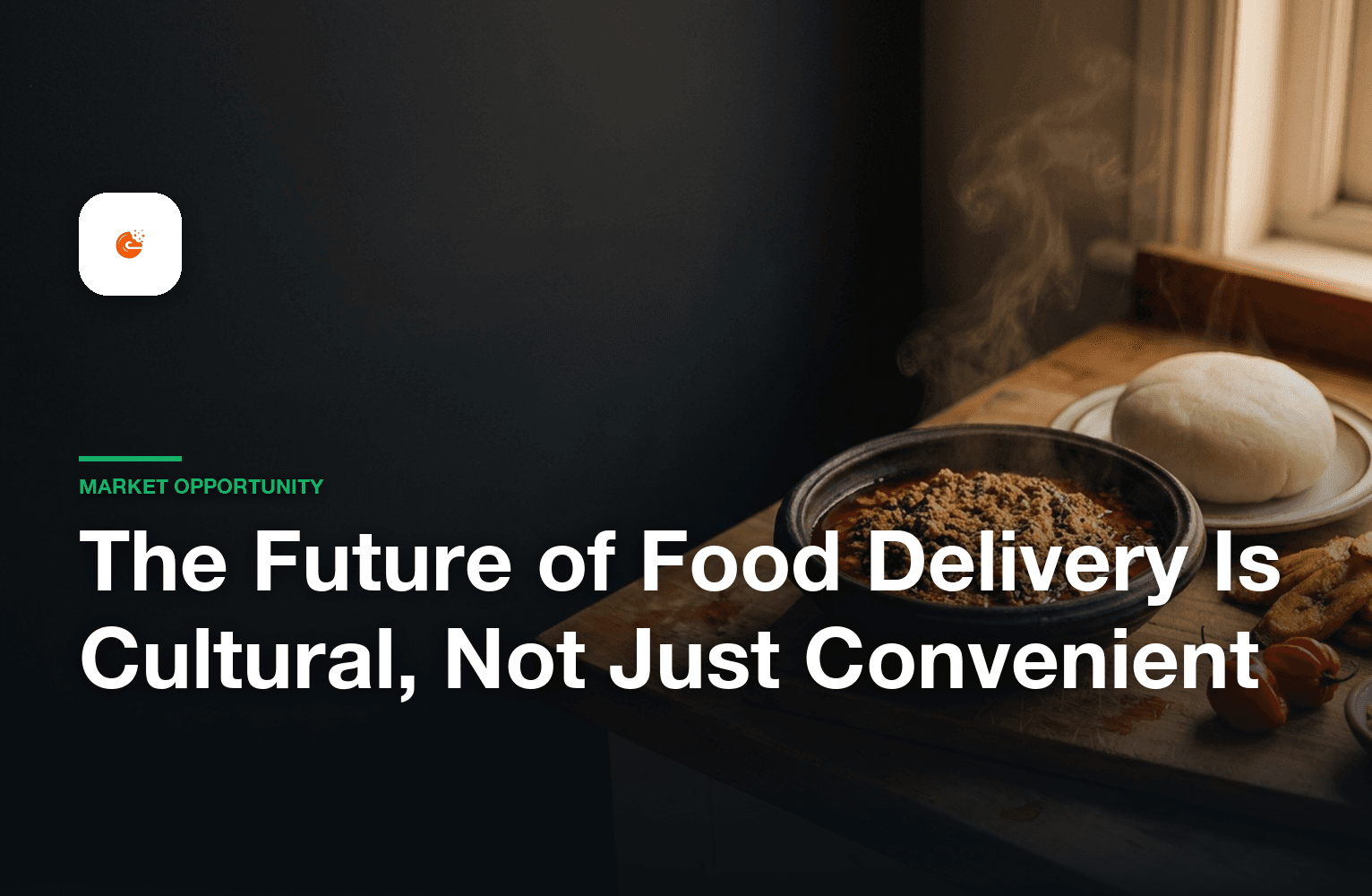
There are three apps on my phone that can put dinner at my door in under thirty minutes.
Not one of them can get me egusi.
That is not a technology problem. It stopped being a technology problem a long time ago.
Here is where the industry actually stands. DoorDash holds a little over half of the United States food delivery market, Uber Eats about a quarter, and Grubhub most of what is left. Between them, roughly ninety five cents of every dollar.
And order growth on those apps has slowed to around five percent a year, the weakest stretch since the pandemic.
When three companies own that much of a market and the growth curve flattens, it means the race they were running has been run. Speed is solved. Coverage is solved.
Convenience is not a feature anymore. It is a floor.
So what is left?
The question nobody in this industry has answered is much simpler than logistics. It is whether the app carries the food you actually eat.
The thing that was never a niche
I have watched people talk about this market as an add-on for years. A cuisine filter. A category to get to eventually.
Here is what that misses. For a huge number of households in this country, the app is not slightly incomplete. It is useless for the meal that matters.
You can order a burger in four taps and then get in your car and drive forty minutes for palm oil. Both of those things happen in the same evening, to the same person, on the same phone.
That is not a preference gap. That is an entire trip that delivery never touched.
And people are telling you about it with their gas money. Shoppers in this country routinely visit more than one grocery store in a single week, and Latino shoppers, who make up about a fifth of the population, show up at specialty grocers far more than their share would predict.
Nobody makes two trips for fun.
The easy version of this argument is wrong
I want to be careful here, because there is a lazy way to make this case and I am not going to make it.
The lazy way is to say immigration is rising, so this market is rising. Point at a demographic curve and let it do the work.
That curve is not clean. The foreign-born share of the United States population reached its highest level in about a century early last year, and then by the middle of the year it fell, for the first time since the 1960s.
If my whole argument rested on that line going up, I should tell you it wobbled.
It does not rest there. It rests on something slower and much harder to reverse.
A family that has been here forty years still cooks the food. My children are American. They were born here, they speak like it, and they still want the stew their grandmother made.
Food is the last thing a household gives up and often the only thing it never gives up at all. That is not a market trend. That is how memory works.
And the palate did not stay inside the diaspora either. It broadened.
Grocery already figured this out
Watch where the shelves went, because retail votes with concrete and it does not vote sentimentally.
Kroger launched a Hispanic-inspired private label line in late 2023. Big Y widened its Hispanic section the following year. SpartanNash has been taking its Supermercado Nuestra Familia banner into new states.
Meanwhile the specialty grocers are not waiting to be included by anyone.
T&T came into the United States at the end of 2024 and is expanding on the West Coast. 99 Ranch opened a two-story grocery and food hall in Queens. H-Mart has a Bay Area flagship in the works this year.
That is a lot of capital moving in one direction. Grocery read the room.
Delivery did not follow.
The apps that will take you anywhere still cannot take you to the store on Route 1 that closes at six, and that store is the entire reason a family drives across a county line.
What building for this actually takes
I think the reason delivery skipped it is that serving this properly breaks the model the big platforms optimized for.
Their economics reward density. A dozen restaurants inside one square mile, orders stacked, couriers looping tight. That is a beautiful system and it is the wrong system here.
Because the store that carries what you need is not around the corner. Building for this means building for distance instead of density, which is a different set of tradeoffs and a different cost structure, chosen on purpose.
It also means the long tail is not a rounding error. A shop that stocks four hundred items no chain carries is not a marginal listing to be added in phase two. It is the whole reason someone opens the app at all.
And it means treating affordability as part of the design rather than a promotion that expires. If the fee structure forces a store to raise its prices, then the app made the food more expensive and called it convenience.
None of that is exotic. It is just a different starting point, and you cannot bolt it onto a platform built for identical sandwiches.
Why I keep coming back to this
I did not set out to build a delivery app. I set out to fix a grocery run.
My wife was having a difficult pregnancy and every week meant two stops. One for the ordinary shopping, one for the African store that closes early and sits nowhere near the first.
Two hours, for food that should have been on one screen.
When I went looking for why nobody had built it, I did not find a hard engineering problem. I found a market that had been mislabeled as small by people who did not eat this way.
That is what ETNOWE ("EAT-NOW") is. Not a cuisine filter added to somebody else's app. A platform that starts from the assumption that your kitchen is normal.
I should be honest about where we are. We are not the biggest platform and I am not going to claim otherwise. We are building in the places where the gap bites hardest, which right now means Dallas, Houston, Atlanta, Washington and Baltimore.
But I would rather be early to the right question than late to the wrong one.
The first decade of food delivery asked how fast dinner could arrive. Everyone answered it, and the answers all look the same now.
The next decade asks whose dinner it is.
If that sounds like your kitchen, come and see whether we carry it. On iPhone, download the ETNOWE app on the Apple App Store. On Android, get it on Google Play.
And if we are missing a store you love, tell us. That is the list we build from.
By Ebenezer Oyinlade, Founder of ETNOWE